About Me

My photo
I'm a guy who likes to cook, eat, and drink, but not necessarily in that order. This blog is nothing fancy; just my random thoughts about anything that can be baked, roasted, or fried. Enjoy!

Tuesday, February 25, 2014

You Say “Tow MAH Toh” I Say “Tow MAY Toh"

For dinner the other night I roasted tomatoes, and it got me thinking about the Academy Awards of all things! (I know this seems odd, but it’s how my brain works—bear with me here.) In particular, I realized that the tomato resembles a Hollywood movie star.  Like those stars and starlets gliding across the red carpet, everyone goes gaga over the tomato. The tomato is the Scarlet Johansson or the Keira Knightley of the food world—the smooth shiny, bright skin; the perfect balance of sweetness and acidity; the versatility. And like a beautiful movie star who must “go ugly” to win an Oscar (think Charlize Theron in Monster), tomatoes now have the “ugly” heirloom in order to be taken seriously by the urban foodie hipster.

But how did the tomato become such a star? To push this analogy to its limits, the tomato, like Norma Jean and many other movies stars, comes from humble roots. (No pun intended!)

The tomato is originally from present-day Peru, once part of the Inca Empire. After the Spanish conquered the Incas, the tomato made its way to Spain in the 16th century, and from there to Italy, France, and even England. (Though for anyone who has tasted traditional English “food,” it is clear that the tomato was wasted on the English.)

Today we cannot imagine food without the tomato. In France, there would be no ratatouille; in America, no pizza; in Italy, no spaghetti.  Until the 18th century, however, the tomato was thought to be poisonous and remained ornamental, going by such lyrical phrases as “Peruvian Apple,”“Acacia Apple,” or the “Love Apple” in France. Thomas Jefferson apparently stood on the steps of Monticello and ate a tomato publicly to prove that it was not poisonous.

While the tomato today is no longer considered poisonous, it is not without controversy.  The tomato has become the boîte noire of modern food production; a tempestuous melange of food, history, geography, and even politics. 
And the epicenter of this controversy resides in California. (Ironic, huh?!) 

As Evan D.G. Faser & Andre Rimas point out in their 2010 book, Empires of Food (2010), “[m]odern agriculture reached its apogee in California.” More specifically, they note that “[i]n the annals of human agriculture, rarely has any fruit proved as profitable as the California tomato.” Point of fact: tomato processing is now the second-largest processed food business in North America after frozen potatoes.

Of course this revolution in food production has fed a lot of Americans, who spend less on their food than just about any people on the planet. And of course, every revolution has its counter-revolution. Enter the “slow food movement,” the “locavore movement;” the “heirloom tomato” movement. 

And while I don’t fault all these movements—they have their merits—they may be based on a false premise. Food has never, truly been “local” or truly “natural.” Even the most non-GMO wheat, corn, barley, or carrots ever grown are all derived from  variants genetically modified over many generations in the ancient world. (Granted, we can do it a lot faster now and maybe faster than our bodies can adapt to the changes.) And food and flavors, like people, have always migrated from place to place. As Faser & Rimas state: “[a]part from inside a patch or two of Amazonian bush or a forgotten New Guinean gully, there’s no such thing as a purely regional cuisine. Promiscuity in foodstuffs is part of human nature.” 


So, when food gets political, as it is wont to do these days, don’t forget that there never was a “golden age” where we were in harmony with food production. Of course, this is not to say we shouldn’t be mindful of the future—just don’t forget about the past. And don’t forget that “ugly” ain’t always better.

Tuesday, February 18, 2014

The Father of the Modern Restaurant


"La bonne cuisine est la base du véritable bonheur.” [Good food is the foundation of genuine happiness.”]

This past Friday, as we all know, was Valentine's Day. Next to flowers and heart-shaped boxes of chocolates, dining at a nice restaurant is perhaps the most popular Valentine's Day tradition. But I wonder how many of those love birds knew that they owed their dining experience to Auguste Escoffier, perhaps one of the greatest of French chefs.  

France awarded Escoffier the Legion of Honor
in 1920, the first for a chef.
 
Escoffier’s contribution to the modern restaurant trade began as a field cook during the Franco-Prussian War, where his emerging skills were tested by learning to improvise with scanty rations and horse meat. But his career took flight when he collaborated with the hotelier César Ritz at the Savoy Hotel in London. It was Escoffier who made the Savoy world-famous. 

Escoffier became obsessed with kitchen reform. Perhaps because of his military experience, he created the hierarchal brigade de cuisine that is still used today in most restaurants. Another innovation attributable to Escoffier and that almost every restaurant patron experiences even today, is the printed menu with the courses listed sequentially. He was also the first to outfit waiters in ties and aprons. And perhaps to the disdain of Anthony Bourdain and Gordon Ramsey, Escoffier banned shouting and alcohol in the kitchen. Escoffier also  published Le Guide Culinaire, a book still used in culinary schools throughout the world. Thus, it is safe to say that Escoffier made cooking a profession.

Escoffier may even have been a nascent feminist! He enticed English women to eat in a restaurant, at a time when respectable women simply refused to dine in public. (There’s a scene in a recent episode of “Downton Abbey” that alludes to this.) He is known to have named numerous dishes after women (e.g. Peach Melba). Ever the charmer, Escoffier was once quoted in the New York Times as saying that “[n]othing adds so much zest to a good dinner as to have a pretty woman sitting opposite you.” Charm indeed!

Escoffier died at the ripe old age of 88 on February 12, 1935, only a few weeks after his wife. Surprisingly, Escoffier's wife cooked all his meals when he was home. Of his wife, Escoffier said that “Mme. Escoffier cooks far better than I do.” 

So for all you romantics who enjoyed a Valentine’s Day meal with impeccable service, beautiful printed menus, and enticing dishes with exotic names, you have Escoffier to thank.  Bon appetit!


Sunday, February 9, 2014

Thirty-Six Hours in New Orleans

“New Orleans food is as delicious as the less criminal forms of sin.”  ― Mark Twain

© 2014 Chris Terrell
That New Orleans is a major gastronomic destination can hardly be disputed. Within its confines, one will find food both low-brow and high-brow, and everything in between. Everything from po-boys and red beans and rice to high-end French. What may be less evident is how New Orleans became the center of creole cuisine that we know today.

It is a port city that, over many, many years, welcomed an immense variety of humanity: French, Africans, Spanish, Portuguese, and Asians. As a port city, somewhat isolated from the rest of the United States, it cultivated a certain openness and joie de vivre that fostered culinary experimentation. After all, the unofficial motto for New Orleans is "
Laissez les bons temps rouler"—“let the good times roll!”

I love New Orleans. I love its insouciance; its practiced shabbiness. 

A few weeks ago, I had  the opportunity to share my love of New Orleans with my two boys. This was their first trip to the Big Easy. We left around 2:00PM on a bright, clear, somewhat warm Friday afternoon. They were out of school because of the recent snowstorm that had hit Birmingham earlier in the week. It is not a bad drive from Birmingham to New Orleans. A straight shot on interstate the whole way.

We would stay at a condo in the Warehouse District with my dad and his significant-other, Veronica. The kids were excited for different reasons. My son Hamp, who has a strong interest in anything martial, was looking forward to the WWII Museum. My son Forrest, who has a strong interest in anything that can be eaten, was looking forward to the restaurants.

By the time we settled in and I had parked the car, it was close to 8:00PM. We were all pretty hungry. Though I was unfamiliar with the Warehouse District, there was no shortage of places to eat. It was late, and we were not necessarily looking for fine dining. We ended up at Lucy’s Retired Surfer Bar on the corner of Girod and Tchoupitoulas. This worked out well. Hamp and I both got hamburgers, which were quite good. Forrest got the special: catfish over rice, which was also quite good.

The next morning was another clear, beautiful day. After I had a quick run along Old Man River, we headed off to the WWII Museum. Breakfast that morning was a surprise. We came across the Crescent City Farmers Market at the corner of Girod and Magazine. It is open every Saturday from 8:00AM to Noon. I grabbed a croissant and some chicory coffee. Forrest grabbed a muffin the size of his head. Fully fueled, we headed off to the museum

After the museum, it was pushing noon. We were all hungry. One thing that Hamp (the non-foodie son) and I share is a love—some would say, a passion—for pizza. For me, pizza and beer is one of the perfect food-drink combinations. But beer, pizza, and Saturday afternoon is the perfect food-drink-time combination. Now the trick was to find a pizza place without knowing where to go. I’m a big fan of Urbanspoon. I pulled out my iPhone and fired up my Urbanspoon app and found a place that looked promising: Dolce Vita on St. Charles. It had a 100% rating. 

We were not disappointed. This was some of the best pizza I’ve had outside of NYC! Believe it or not, the chef and owner, Bogdan Mocanu, is not Italian, but Romanian! He grew up cooking with a wood-fired oven and was trained in John Besh’s restaurant, Domenica, so he knows what he’s doing. The story of how he ended up in New Orleans is interesting. He had a food truck in Baton Rouge, but it got totaled by a drunk driver. Only in Louisiana! Bad for him, but good for us. 

By this point, my enthusiasm and love of walking and exploring new places had taken its toll on my little tour group. My dad, Veronica, and the kids were tuckered out and ready to nap. I dropped them off at the condo, and after a quick 15-minute power nap myself, I grabbed my camera to take some photographs in the French Quarter—a “target-rich environment” for any photographer. 


© 2014 Chris Terrell
That night we had 8:30PM dinner reservations at Cochon, a restaurant that I had been trying to get into for the last three trips to New Orleans. Because I had some time, and happy hour had just arrived (isn’t it always happy hour in New Orleans?!), I decided to meet up with two dear friends who live in New Orleans: Victor and Jennifer. Victor is an amazing jazz pianist who teaches at the University of New Orleans and Jennifer owns a children’s clothing store in the Garden District on Magazine. 

We conspired to ditch our kids and meet for drinks at Delmonico on St. Charles. Delmonico is one of Emeril Lagasse’s restaurants. Now, I don’t know about the food, as I’ve not eaten there (Victor and Jennifer agree that its good), but if the food and service is anything like the bar, then “bam!” I’ve got to try it. I had a Sazarac—of course!—and a rum punch (emphasize the word “punch”). Both drinks were perfect. And the service! Usually, I time my second drink so that there is a little bit left in the first one, so as to ensure no lag time. No need!  I had barely taken another sip after I placed my rum punch order and “bam!” there was my drink. Gotta go back to this place!


© 2014 Chris Terrell
As I mentioned, dinner that night was at Cochon. “Cochon” is French for “pig.” An appropriate name, for this place is all about  pork! And speaking of “pig,” we pigged out! 


Here’s what we had: 
  • Wood-fired oysters with chili garlic butter 
  • Shrimp & tasso ham with charred greens & field peas 
  • Fried livers with pepper jelly & toast 
  • Smoked pork ribs with watermelon pickle 
  • Rabbit & dumplings 
  • Oven-roasted gulf fish “fisherman’s style 
  • Oyster & sandwich 
  • Macaroni & cheese casserole 
 And for dessert we had:
  • Farmers cheese and Meyer lemon pie 
  • Chocolate peanut butter pie with candied spicy peanuts 

After we stuffed the last bite into our mouths and paid the bill, we then made the long oscitant walk back to our condo, groaning with delight at the awesome meal we had just had. 

We slept in late the next morning and then headed off to Cafe du Monde for beignets and cafe au lait. But before heading back to Birmingham, I gave in and took my kids for a stroll down Bourbon Street. Okay, so I may not win parent of the year, but at least it was a Sunday afternoon. Bourbon Street was relatively calm. After picking up some king cakes at Rouses on Royal street, we had to hit the road and head back to Birmingham.


© 2014 Chris Terrell
A few days later, I got to thinking about New Orleans. I recalled that in law school I made jambalaya all the time. It is a great dish—cheap, simple, and sustaining. Having just been to New Orleans, I decided I would make it again. When I made jambalaya back then, I relied heavily on The Joy of Cooking, my one and only cookbook. Consequently, I cracked open the latest edition and looked up the recipe for jambalaya. 

I was a bit  underwhelmed. 

It seemed like such a good recipe eighteen years ago, but not now. It lacked flavor. No worries. I took the basic recipe and improved upon it.  Maybe I've changed. Maybe I'm a better cook. Anyway, here's my version:


The Insouciant Chef’s Jambalaya

Ingredients

3 tablespoons butter
16 oz. andouille sausage 
1/2 cup red wine
1 medium chopped yellow onion
3 garlic cloves minced
1 medium green bell pepper, cored, seeded, and diced
1/2 cup diced celery
1 cup extra long-grain rice
2 tablespoons tomato paste
2 cups warm chicken stock
14 1/2 oz. can of whole tomatoes with juices
1 tablespoon of dried thyme 
1 tablespoon of dried oregano
2 tablespoons of paprika
1 tablespoon of cayenne pepper
salt and pepper to taste

Preparation

In a dutch oven, melt the butter and add the sausage and brown. When the sausage has browned, pour in red wine and de-glaze the pan, then add the onion, green pepper, celery, and garlic and simmer over low heat for about 2 minutes. Then add rice and tomato paste and stir to coat.

Add chicken stock and tomatoes (crushing tomatoes by hand).

Add bay leaf and other spices and simmer for about 45 minutes to one hour until thickened and rice is soft.

Salt and pepper to taste. (Of course, you can adjust the spices as you wish depending on how spicy you like your jambalaya.)

Bon appétit!

Monday, February 3, 2014

Snow Day!

If you were any where near a television last week, then you saw the coverage of Snowmageddon 2014 here in Birmingham, Alabama. Yeah, I know you Yankees get a laugh watching us Southerners have a collective freak-out over two or three inches of snow. Well, it doesn’t take much; we don’t keep a lot of snow-removal equipment sitting down because snow here is about as rare as a non-SEC team winning the national championship in college football. Maybe we should have taken that win by FSU as a premonition? And can we talk about freak-out? I’ve seen my Yankee friends pass out from the 90+ degree heat/90% humidity we get down here in August.

©  Chris Terrell 2014
Doesn't look like a dusting to me!
After my car got stuck for the third and final time, I locked it up and walked about 3 1/2 miles to my apartment in downtown Birmingham. (And yes, the roads did look like something out of The Walking Dead.) After warming up and changing out of my work clothes, I met up with some buddies to walk around and enjoy the snow day (the office would certainly be closed the next day). And because there’s not much else to do on a snow day, we reconnoitered the area to find a bar that was open. 


©  Chris Terrell 2014
The Long Walk Home
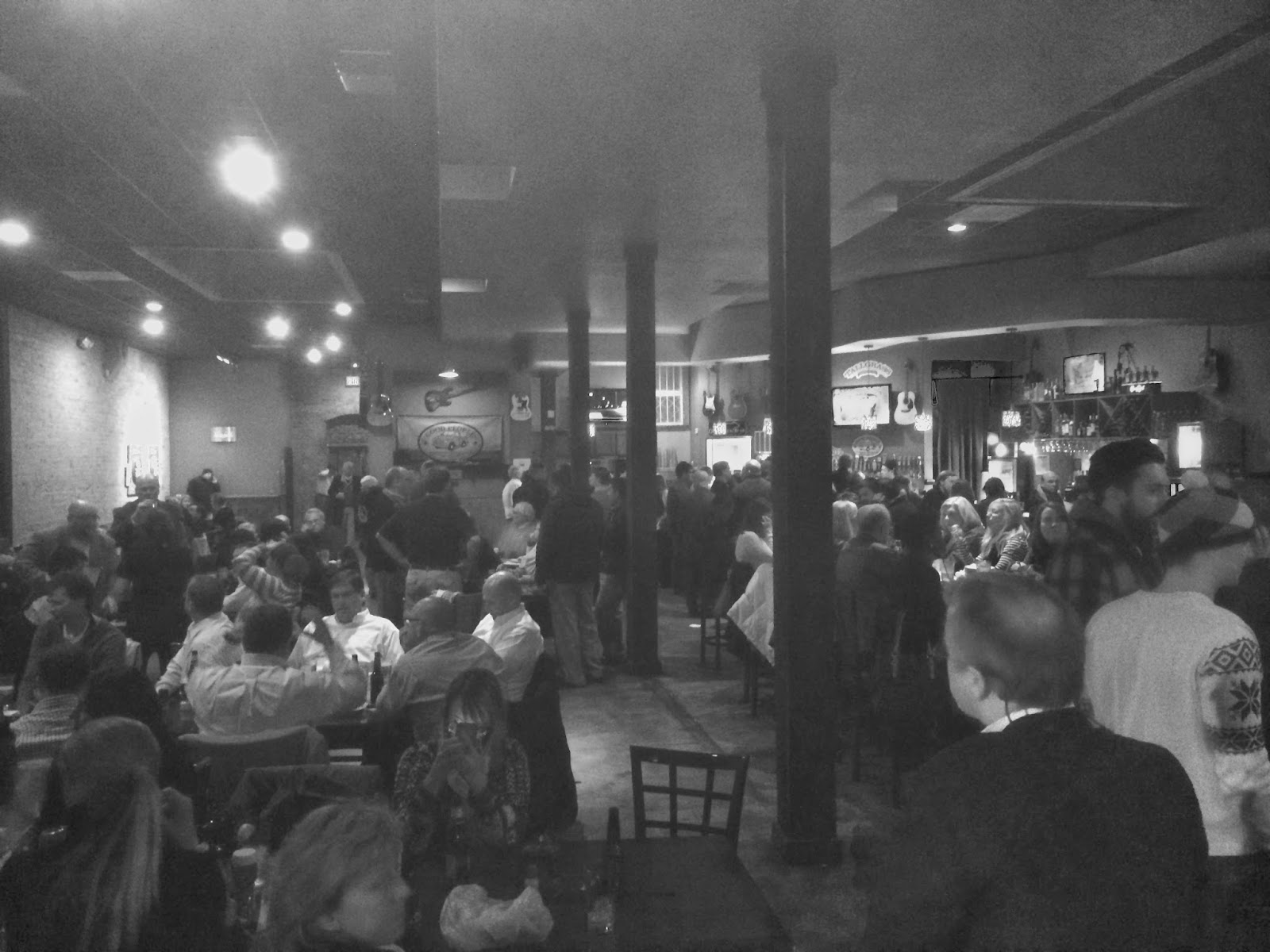
It didn’t look good at first. Paramount: no; Carrigan’s: no; The Collins: no; Pale Eddies: no; Urban Standard (quasi-bar): no. Our last chance was Rogue Tavern. Yes, it was open!  Needless to say, being the only bar open in downtown Birmingham during Snowmageddon 2014, it was packed! 

Remember how excited we were as kids when we got a snow day? But have you seen what happens to a bunch of respectable adults snowbound in a bar!?  


                                                                                  © 2014 Chris Terrell
Because so many people were stranded downtown, Rogue was an eclectic mix of urban hipsters, legal secretaries, overworked lawyers, and bankers. The drinks sitting on everyone’s tables reflected this diversity. In addition to the typical craft brews, there were plenty of chardonnays and scotches. As I said, for a bar, the food at Rogue isn’t too bad, and they ran out quickly. I think my friend Jim got the last hamburger in Birmingham that Tuesday night. 

Not surprisingly, I slept in a bit late on Day Two of Snowmageddon 2014. Because getting to the store was not an option, and there was nothing much to do, at least until the next happy hour, I decided it was time to clear out the fridge and do some cooking. 

In the freezer, I found some ham and black-eyed peas. This formed the basis for a ham and field pea soup. Though, I didn’t have any vegetable stock, I took some carrots, celery, and onions and tied them up in some cheese cloth and placed them in the water. Something like a giant bouquet garni. Bingo! Vegetable stock! And in a couple of hours, with a bit of cayenne pepper and ancho chili powder, I had soup!

Next, I took some eggs, plain yogurt, and lemons I found in the fridge and made a lemon yogurt cake from an Ina Garten recipe. And, with a few lemons leftover, I made lemon-pepper chicken paillard from a Bobby Flay recipe. A quick vinaigrette and some green leaf lettuce and “voila!” I had dinner. After dinner and a good movie, it was off to The Collins (now open) because the office would be closed the next day too! 

You gotta love snow days!


Monday, January 27, 2014

Some Memories are Best Served from a Can

I have heard that the sense most closely associated with memory is smell. Not being much of a science student growing up, I have no means of challenging this theory, though it makes sense. Walk into a room and smell nutmeg and cinnamon, and you think Thanksgiving or Christmas.If you smell hamburgers on a grill, you may be reminded of summertime trips to the beach, fighting with your sibling over that imaginary line in the back seat. And if you are of a certain age and you smell buttered popcorn, you may recall when you saw Star Wars for the first time in an actual movie theater—the original one, before it was Episode IV.

Of course, our perceptions of the past are less than trustworthy, and even the present can be a tricky thing. As Milan Kundera said, it eludes us completely.” How we perceive the past and the present, and what we expect of the future, is the central theme in a delightful book I read recently: Provence, 1970. It is written by Luke Barr, the grand-nephew of M.F.K. Fisher, and based on a journal written by Fisher that Barr found in a storage shed. The journal recounts Fisher's trip to France in December 1970 and her encounters with some of the culinary stars of her day: Julia Child, Simone Beck, James Beard, and Richard Olney. But more importantly, Provence, 1970 addresses the tension between tradition and the new, increasingly apparent in Americas culinary scene of the early 1970s.

This book reminded me of my own discoveries of food and cooking. (I was born in 1970 and came of age in the 70s and 80s.) Like most kids, Im sure I was not unusual. While I was not too picky, and though I had a healthy appetite, there were things that I liked; things that I tolerated; and things that I loathed with a passion. Brussels sprouts fell into this latter category. They were known to causeand Im not kiddinga gag reflex. One evening, my mother decreed that I could not leave the table until I finished my vegetables, in this case Brussels sprouts. And being a kid who didnt like rules (and later growing into an adult who likes them even less), I grabbed my napkin, wrapped them up, and hid them behind the piano. 

Done! Can I go watch Battlestar Galactica now?” 

Unbeknownst to me, I had committed a grievous tactical errorI had forgotten that my grandmother was visiting. She, being the original wearer of the been-there-done-thatt-shirt, had witnessed all the numerous vegetable-avoidance schemes firsthand. She easily smelleda rat. With the olfactory precision that would have made a Louisiana bloodhound proud, she found my shrouded Brussels sprouts in five minutes flat. And talk about gag reflex, try eating Brussels sprouts stone cold and covered in dust bunnies!

Things did improve. I grew to appreciate the finerthings in cooking, though it was a slow process. 

Advance the clock forward about five or six years.

I still remember my first fancymeal. My family had recently moved to the outskirts of Washington, DC, from a small town in southeast Virginia. This was my first foray into the big city. (Before that I had confused Richmond, Virginia, with New York!) We went to lunch at a now-defunct chain called The American Cafe. In keeping with its name, this restaurant sought, with typical American exuberance, to reproduce Parisian brassiere food for the masses. Being a 12-year member of the American masses, I thought this place was the bomb! I ordered the crepe suzette and discovered that there was more to food than bologna sandwiches and cheese doodles.  

Good or bad, how Americans think about food and what they eat has changed a lot since that crepe suzette in 1982. As Barr points out in his book: There is more good food and cooking than ever in America, and more hype, spectacle, money, moralizing, and pontificating, toomuch of the discussion still circling around the same undying questions of authenticity, elitism, and taste that divided Child, Olney, and the others.In other words, snobbery is nothing more that the zeal of the recently converted.

We shouldnt let that food-snobbery blind us to what was good about how we ate back in the 70s. I loved my Moms spaghetti, even if it come from a jar. However, is spaghetti from the hot barat the local Whole Foods such a big improvement? And yes, vegetables came from a can, but are those kale-carrot smoothies made in a Vitamix a step forward? And with all the recent talk about GMOs and food dyes, gluten-free this and that, I can't forget the Technicolor glories that one could create with FDA Blue #6.

While visiting my grandmother during my birthday, my mother asked me what kind of birthday cake I wanted. This was back in the day when moms still made birthday cakes and those cakes typically came from a box. I said blue, because blue was my favorite color that week. And my Mom, like any dutiful mom in 1977 found some blue food coloring in my grandmothers pantry and made me a birthday cake that was the most perfect electric blue in the world. Why? Because I had asked for it, and she loved me, so she made it. 


Yes, we Americans are probably more sophisticated about our food and how we prepare it than we were thirty, twenty, or even ten years ago. But have we gone too far? Yes, locally sourced kale is one thing, but Ill take a can of green beans, Kraft Mac-n-Cheese, a bottle of Lambrusco, and reruns of All In The Family  with friends and family any day.

Sunday, January 19, 2014

Like Good Writers, Good Cooks Steal

I’ve never been all that big into New Year’s resolutions. At the end of the day, they are nothing more than exercises in futility that leave us feeling disappointed, if not down right guilty by the middle of April.  As Mark Twain once said of New Year’s Day: “Now is the accepted time to make your regular annual good resolutions.  Next week you can begin paving hell with them as usual.”

That being said, I decided that I would nevertheless come up with a few “goals” for 2014.  I didn’t write these down and, therefore, unlike resolutions, they are more “aspirational.” Now I won’t feel guilty when they get cast aside or don’t come to fruition. 


© 2014 Chris Terrell
First recipe of the new year!
One of these goals was to be more creative in the kitchen and to come up with more of my own recipes in order to grow as a cook. As Julia Child pointed out, “[y]ou learn to cook so that you don't have to be a slave to recipes.”  Thus, if you really want to free yourself to be a better cook, then you need to take some chances and fight the urge to crack open a cookbook every time you fire up the stove. After all, there aren’t many famous cover bands out there.

Don’t get me wrong, I’m not about to throw out my cookbooks any time soon. (I bought yet another one the other day!) I will still use many recipes and will read many others that I have no intention of making. If anything, recipes act as a catalyst for making one a more independent cook through the practice of technique. Each recipe has at its core some basic techniques that open numerous possibilities. For example, once you have mastered sole meuniere or chicken marengo, then you can take the basic concepts in those recipes and create a whole cookbook-worth of personalized dishes.  As Tom Colicchio once said: “Recipes tell you nothing. Learning techniques is the key.” I couldn’t agree more.

However, when I started to think about the dishes that would be mine and mine alone, I quickly discovered that they were nothing more that riffs on other people’s recipes, whether they belong to my Mom or Bobby Flay. But like good writers, good cooks steal! So what follows is a soup recipe that “borrows” from both Julia Child and Mimi Thorisson.

In thinking about this recipe for a few days during my morning runs—yes, I think about food when I run! —I decided I wanted something simple, yet rich but not heavy. As many of my friends will tell you, I love French cooking, especially its use of sauces. One of the “mother sauces” that works well in creating a soup is a velouté sauce. A velouté sauce is a white, stock-based sauce thickened with roux. A roux is a near-equal mixture of melted butter and flour. One of my favorite soups is leek. I also like anything with ham or bacon. Combining these flavors with a velouté sauce should, therefore, make for a good soup. And last night, I gave it a try. I must say it was pretty darn good, if I say so myself. Of course, it is a work in progress and subject to change on a whim. In fact, once I’ve come up with a recipe, it rarely comes out the same way twice, even if I write it down. 

Anyway, here it is:


Leek Velouté with Serrano Ham

Serves 4-6

Ingredients

 3 1/2 cups stock (chicken or vegetable—I used chicken)

1/2 cup dry white wine

1 cup water

3 medium sized leeks (white and pale green parts only)

8 tablespoons butter (1 stick)

1/2 cup all-purpose flour

bouquet garni (thyme, parsley, and bay leaf)

Serrano or Iberico ham

salt and fresh ground black pepper to taste

Preparation

Slice the leeks thinly (1/8 inch thick) crosswise and place in a medium-sized pot with the stock, wine, water, and bouquet garni. Bring to a boil and then reduce to a simmer.

Make the roux by melting the butter in a small pot over low heat and gradually adding the flour by whisking continuously until the roux is thick and smooth. 

Slowly combine the roux with the stock and stir until well incorporated. Continue to let the soup simmer at low heat for 30-40 minutes. 

While the soup simmers, preheat the oven to 425 degrees. Take 4 to 6 slices of the ham and place on a non-stick baking sheet. Cook in the oven for 6-8 minutes or until crispy. Let the ham cool, and then crumble.

Place the soup into a blender or use an immersion blender and blend until smooth. Add salt and pepper to taste (keep in mind that stock already has salt in it).

Once the soup is done, serve in bowls and garnish with the ham.

Bon appétit!

Monday, January 13, 2014

“Your Table is Ready” Part 2

© 2013 Chris Terrell
A few weeks ago, I wrote about my recent trip to New York and my “method” for picking the restaurants that I wanted to visit while I was there. This is the second part of that post, in which I reveal the restaurants I visited. There were some unexpected surprises and a serendipitous change of plans.

We arrived on January 1, and being from the South I felt compelled to eat collards and black-eyed peas. This would have required a special trip to Harlem to eat what New Yorkers call “soul food” or “Southern cuisine.” We just call it “food” down here. But alas, we were tired from a late night dinner in Washington, D.C., the night before, so we decided to keep it local. But where? We were staying in a very nice hotel in Midtown. I asked the concierge—an under-used service—who steered us in the right direction.


Brasserie

The best feature of this restaurant is its setting. It is located in the Seagram Building and has been there since the building opened in the late 50s. The atmosphere is right out of Mad Men—very mid-century modern. And if you like martinis with your lunch/brunch, theirs are very good. But caution—they are strong! They would knock Roger Sterling on his ass!


P. J. Clarke’s

For dinner that night, we wanted to keep it low key. We had enjoyed a late lunch earlier in the day and were not that hungry. So we went to P.J. Clarke’s for some appetizers. I had more than a few Manhattans, so my recollection on what we had may be suspect. We started with the jumbo shrimp cocktail, and when the menu says “jumbo,” they ain’t kiddin’! These things were right out of 20,000 Leagues Under the Sea! The culinary highlight of the evening, however, was the parmesan tater tots with smoked ketchup. The tater tots in 10th grade were never like this!


The Modern


©2013 Chris Terrell
For me, no trip to New York is complete without a visit to my favorite museum, The Museum of Modern Art, or MoMA for short. I love MoMA! And a visit to MoMa would not be complete without lunch at The Modern, Danny Meyer’s restaurant next door. The decor exudes a confident, modern sensibility in keeping with its neighbor.  We had a table in the bar area. Shortly after we arrived, however, the real entertainment began. 

She arrived with an oversized Manolo Blahnik bag and equally oversized sunglasses. I wasn’t sure about her age. She appeared to be about 102 but was probably a well-worn 62. She was with a friend, but we would not hear from her, for she would not get a word in edgewise. If I were a casting director for a Woody Allen movie and needed the stereotypical upper East Side New Yorker from central casting, this woman would have been it. With that accent we love to mock and that only New Yorkers can appreciate, she proceeded to talk about a mutual friend who was a “third wheel.” And when dessert arrived, she was emphatic that they should only have “cawfee”. Linda Richman would have been proud!

And they make fun of the way we talk!

Anyway, she was part of the charm of what was a very pleasant lunch. Here’s what we had:

  • Tarte Flambée—Alsatian thin crust tart  with crème fraîche, onion, and applewood-smoked  bacon
  • Red Endive and Arugula Salad with red kuri pumpkin, honey crisp apple and ricotta salata 
  • Cauliflower Soup with roasted hazelnuts, mascarpone,  and white balsamic 
  • Alsatian Country Soup with Benton’s ham and Nantucket Bay scallops 
And then we went to MoMA. Did I tell you that I love MoMA?!


Alder

Dinner that evening was at Alder. We arrived just as snow was falling.

© 2013 Chris Terrell

Alder is the little brother to Wylie Dufresnes's well-known and well-regarded restaurant WD-50. The menu takes a creative approach to traditional flavors. This is a small-plates restaurant, which gives one plenty of room to experiment. The bar is creative too. I recommend the ample-sized Burnt Reynolds (rye, smoked vermouth, and Campari). I ordered the rye pasta based on various reviews, and I was not disappointed. It tastes just like a perfect New York pastrami on rye sandwich!

We also had the hanger steak, which was excellent, as well as the french onion soup rings. For desert, we had the root beer pudding, which was wonderful.

 The only complaint I had was the hostess. She seemed like someone you would find at a trendy club, assessing whether you were wearing the right shoes. It was snowing for Pete's sake! I had to wear my sensible shoes that night! 


© 2013 Chris Terrell
This is  me at the beginning of the
Sugar Bowl, full of hope and promise
By the time we left, my desire to walk around New York in the snow was quickly squelched. It was a slow cab ride back to the hotel where I watched Alabama in the Sugar Bowl. I won’t go there! But suffice it to say, it is a wonder I didn’t get thrown out into the cold that night given the colorful language I hurled at the TV
.

Candle 79


© 2013 Chris Terrell
They may be vegan, but they know
how to make a mean martini!

This was the real surprise of the trip. If you read my previous post, you know all about this place. Candle 79 is a vegan restaurant in the Upper East Side. A wonderful experience of the new. 


Becco

Friday night was the theater. We were going to see one of the hottest shows in New York: Pippin. On the night you go to the theater, your options on dinner are limited by time and space. First, you need to eat dinner early, as most shows start around 7:00 or 8:00pm. Second, is distance. You don’t want to have dinner in the Williamsburg section of Brooklyn when you have to be in the theater district by 8:00pm. New York cab drivers are fast, but not that fast.

To solve this logistical Rubik’s cube, we went with Becco. This is one of Lidia Bastianich’s restaurant—home to the famous $25 all-you-can-eat pasta and the truly exceptional $25-a-bottle wine list. The wait staff, knowing that everyone is anxious to make a show, are nevertheless gracious, friendly, and efficient. Anyone going to the theater should stop here.

Dogs & Pizza

© 2013 Chris Terrell

First NYC Street Dog of 2014
We survived the snow storm, but it was still cold. With a late start and lunch a few hours away, I was hungry. As I approached the corner of East 55th Street and 5th Ave., I saw the holy grail. No trip to New York would be complete without a dog from the street.  (My first craving had hit me the night before around 10:43pm after the Broadway show. The only problem was that the temperature was a mere 10 degrees. (Alas, not even the most hard-scrapple street vendor will brave those kind of temperatures.) Anyway, I grabbed a dog with ketchup, mustard, and onions. Then off to the E Train and the 9/11 Memorial.

Afterwards, we went to one of my favorite pizza places in Manhattan: Lombardi’s. This is considered to be the oldest pizzeria in New York. Great pizza and the meatballs are the size of baseballs!  Added bonus! I could’ve sworn I saw a wise guy in the corner!

Chinese Carry-Out

If you have been keeping track, this was our last night in New York. This was the night that we were to have dinner at the big, destination restaurant, Perry St., one of Jean Georges Vongericthen’s restaurants. Dinner reservations were originally for 7:00pm, but got moved to 8:00pm. As I settled into a relaxing hot bath with a bourbon on the rocks, the thought of bundling up to catch the subway and venture out into the cold seemed a lot less appealing, even if it was a top notch restaurant. 

But this was New York!  

And how can you justify taking a glamorous Saturday evening in the city, and turn it into a stay-at-home, pajamas night? The answer came quickly: Chinese food and a movie.  When in doubt go local—this was the city that invented take-out Chinese! We placed a late night order for the requisite won ton soup, General Tso’s chicken, beef and broccoli, and egg rolls.  After a few delays from the relentless weather, dinner arrived.  No need to dress up (except some jeans and a t-shirt to meet the delivery person in the lobby),  and no need to catch a cab, and no pricey tab for dinner.  Just a great night, NYC style, which in some ways stands out as the highlight of the trip. We settled in with our Chinese food and watched a great French movie on my iPad. A perfect combination of the familiar and the modern.

As I mentioned in Part One of this post, eating is a social endeavor, which is why we go to restaurants. But sometimes we don’t need restaurants. All we need is each other.